
The Beliefs Keeping You Stuck as the Octopus (Part 2)
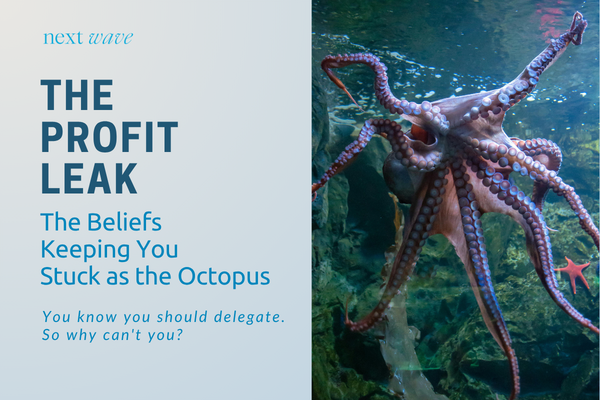
This month's blog builds on last month's, The Profit Leak, where I shared the four stages of business ownership and how our habits create profit leaks if we are not careful. I described Stage 1 business owner as the Octopus. Brilliant. Capable. Doing everything herself.
In order to save your energy and not juggle your business using all eight arms, we need to look at our habits as discussed in the previous blog post, and this month let’s dive into the beliefs that are keeping us stuck. Some of the most common that I have seen coaching 100’s of small business owners are: perfectionism, lack of trust, ego, fear of failure, fear of success, and simply not knowing a task well enough to explain it. All of these quietly convince smart business owners to keep doing everything themselves. And here's the part that trips most people up: they wait to feel more confident in their skills as a business owner before they start to delegate. News Flash: confidence to delegate doesn't come before you let go. It comes after, as a result of doing it.
In Part 1 of this series, we talked about the Octopus phase, the stage where you're personally holding every arm of the business at once, and it's working, but it's costing you more than it's giving back.
If you recognized yourself in that post, you probably also had a quiet follow-up thought: I know I should let some of this go. So why haven't I?
That question isn't about time. It's about belief.
Meet Anna
Anna built her event planning business doing what she loved, festival pop-ups, bachelorette weekends, small personal gatherings that felt creative and personal. But four years in, she was tired in a way that had nothing to do with loving the work. She was juggling a full calendar with a growing family, pouring hours into Instagram content for events that, on a good month, barely broke even.
The math wasn't actually the problem. What she believed about her own expertise was.
To grow, she needed to pivot from selling one bachelorette party at a time to selling curated team-building experiences to entire corporate offices, one sale that could support what ten individual ones used to. But every time she pictured herself in a room full of corporate decision-makers, one thought stopped her: I don't belong here
She didn't go to networking events, because those rooms felt built for someone else. She didn't post on LinkedIn, because it felt like a stage she hadn't earned. And she didn't raise her prices, because some part of her didn't yet believe a "party planner" was worth what a corporate team-building budget could pay.
Over six months of coaching, none of that got resolved by convincing her she was ready. It got resolved by having her show up with my guidance before she felt ready, one networking event, then another. One LinkedIn post, then a follow-up email. A participant minimum she was terrified to enforce the first time, and didn't think twice about the tenth.
Today, Anna owns her expertise in corporate team building outright. She's spoken on stages in front of Chamber of Commerce audiences that once felt entirely out of reach.
She didn't feel confident before she started showing up. She felt confident because she did.
The Beliefs Keeping You in the Octopus Phase
If you're stuck the way Anna was stuck, it's usually one (or several) of these six beliefs and until a trusted advisor like myself points them out to you, you will carry on for years with out knowing the root of what is holding you back.
1. Perfectionism: "It has to be done my way, or it's wrong."
Perfectionism doesn't feel like a flaw from the inside. It feels like standards. But when "my way" becomes the only acceptable way, you've built a business that can't function without you in every seat. What one business coach told me years ago “You bought yourself a job”
2. Lack of Trust: "No one will do it as well as I would."
This is usually true, the first time or even the second. Nobody does a task exactly the way you do it on the first try. The mistake is treating that first attempt as proof the person (or the plan) doesn't work, instead of treating it as the normal cost of onboarding anyone into anything.
3. Ego: "If I'm not the one doing it, what am I even for?"
This one is uncomfortable to say out loud, so most people don't. But if being needed for everything has quietly become part of your identity, letting go of tasks can feel like losing. Your value was never in doing the invoice. It's in the decisions only you can make.
4. Fear of Failure: "What if they mess it up and it costs me the client?"
This fear is rational, mistakes do happen when you hand something off. What's usually missed is the comparison: mistakes also happen when you do everything yourself, exhausted, at 10pm, rushing to the next task. Delegation doesn't introduce risk into a risk-free system. It redistributes a risk that was already there.
5. Fear of Success: "What happens if this actually works and I have to grow into someone new?"
Less talked about, just as real. If delegating works, the business grows. If the business grows, you have to lead people, not just do tasks. That's a bigger, less familiar version of yourself, and some part of you may be protecting the version you already know how to be.
6. Not Knowing the Task Well Enough to Hand It Off
Sometimes it's not fear at all, it's simply that you've never had to articulate your own process. It lives in your brain. You know how to do the task; you've just never had to explain it step by step to another human. That's not a mindset problem, but it feels like one, because it produces the same result: you keep doing it yourself because handing it off feels harder than just finishing it.
Confidence Comes From Action, Not the Other Way Around
I'll delegate once I feel ready.
It's such a reasonable-sounding sentence. But confidence doesn't usually arrive before the leap. It arrives because of it. Anna didn't wait until she felt ready to send her biggest proposal ever to a corporate lead; she felt ready because she'd taken small steps in this direction and was building on her competence and confidence, watched it go imperfectly-but-fine, and collected the evidence her nervous system needed.
If you wait to feel confident before you delegate anything, you can wait indefinitely. Confidence isn't a precondition for action in this context. It's a byproduct of it.
What's Next in the Series
Part 1 was about the different phases of business leadership and how our habits can cost us more than a downturned economy. This post was about understanding your beliefs that keep you stuck.
Part 3 gets practical: how to actually decide what to delegate first, using time studies and a simple capacity assessment, and how to hand off a task step by step without it falling apart the way your fears predict it will. Look for this important article next month as we continue to look for The Profit Leaks and how to adjust them.
FAQ: Mindset, Delegation, and Confidence as a Business Owner
Why is it so hard to delegate even when I know I should? Usually it's not a logistics problem it's a belief problem. Perfectionism, lack of trust, ego, and fear of failure or success all produce the same behavior: holding onto tasks longer than the business actually needs you to.
Does confidence come before or after taking action? For most people, after. Confidence is built from evidence, and evidence only comes from having tried something. Waiting to feel confident before delegating usually means waiting indefinitely.
What's the difference between fear of failure and fear of success in business? Fear of failure is the worry that delegating will go wrong and damage the business or a client relationship. Fear of success is subtler; it's the worry that if delegating works, the business will grow into something that requires a different, less familiar version of you to lead it. The business now expects something from you.
How do I start delegating if I don't feel ready? Start smaller than feels necessary. Pick one low-stakes task, hand it off imperfectly, and let the result, not your comfort level going in, be the thing that tells you whether it's working.
Ready to Scale? Hire a trusted advisor like myself to help you overcome these beliefs and create new habits to help you grow both professionally and personally.
Women Entrepreneurs hire me as their business coach to scale their profits. I help service-based business owners increase their net income by up to $4000 more every month without hustle and burnout and following my 3-step framework.
SUBSCRIBE TO FOLLOW THE SERIES
Want to find your profit leak in 60 minutes? Join me live for The Hidden Profit Leaks That Are Costing You A Successful Business — a free live masterclass for women small business owners.
>>>Register Here<<<
Jennifer Kok is a Profit and Business Growth Advisor for women entrepreneurs and the founder of Next Wave Business Coaching. She has spent more than twenty-five years building, leading, and selling businesses and today she helps women small business owners identify exactly where their profit is leaking and build the habits that keep more of it. Learn more at nextwavebusinesscoaching.com


copyright 2025 next wave business coaching | all rights reserved | design by mackenzie